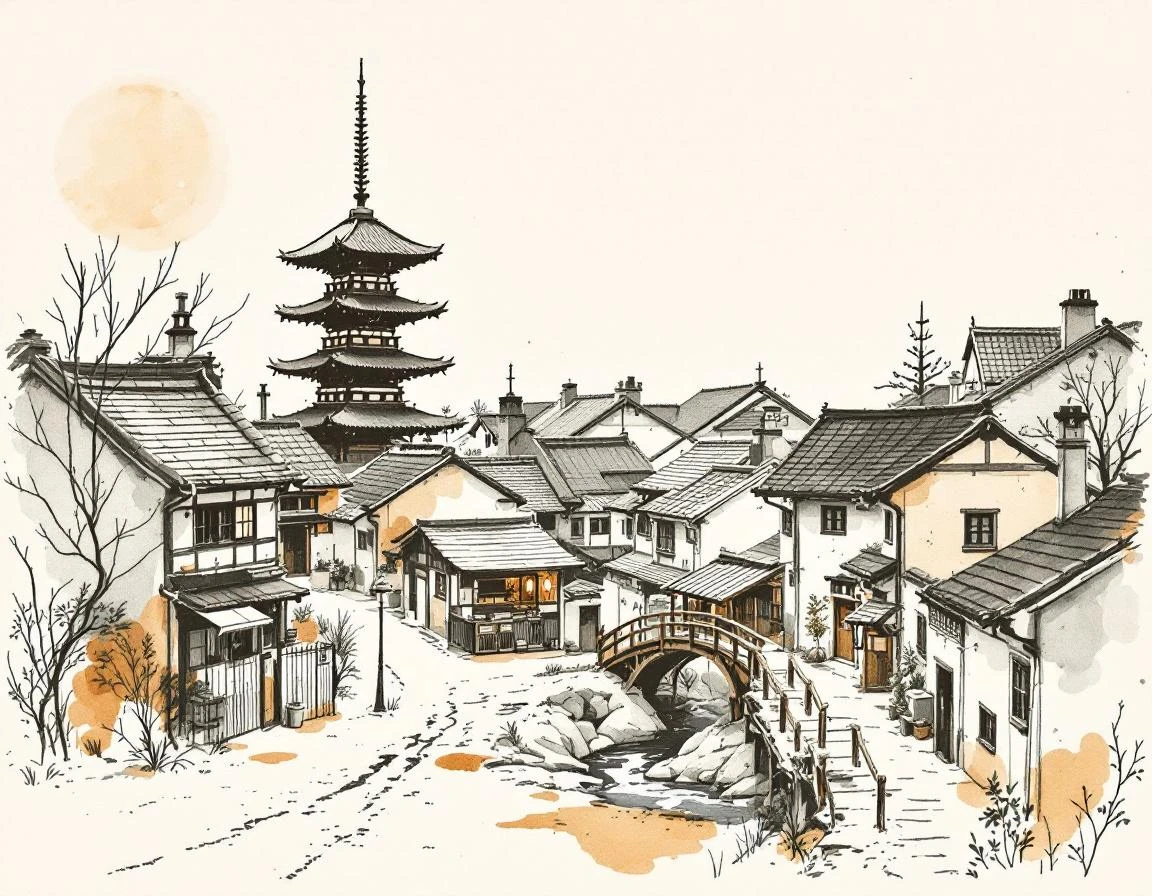

East Asian Town and City Naming Traditions
East Asian place names carry thousands of years of settlement history, shaped by each society's political structures, writing systems, and cultural assumptions about the world. Chinese city names often compress geography and history into two or three characters. *Nanjing* means "southern capital," *Beijing* "northern capital" - a pair that only makes sense relative to each other, and to whichever dynasty was doing the naming. Many names layer a natural feature (river, mountain, direction) over an administrative designation, so the same character compounds appear across provinces, distinguished only by context. The Tang and Song dynasties standardized much of this vocabulary; later empires inherited it, sometimes renaming cities for political reasons, sometimes leaving names that had long outlived the kingdoms they described. Japanese place names draw on a different logic. Many predate the adoption of Chinese characters and were later fitted with kanji chosen as much for sound as meaning - a practice the *Man'yōshū* compilers were already grappling with in the eighth century. *Nara*, *Osaka*, *Kyoto*: the characters gesture at meaning but the names themselves are older than the writing. Coastal and mountain villages often preserve Ainu or other pre-Yamato roots that even contemporary Japanese speakers cannot parse without specialist help. Korean toponyms were systematically revised during the Goryeo and Joseon periods to align with Chinese administrative conventions, then revised again under Japanese colonial rule, then again after 1945. A single town may have cycled through four or five official names in a century. The current names often feel stable and ancient, but that stability is recent - a political decision as much as a linguistic one.
Chinese Naming Foundations
Chinese place names rank among the world's oldest continuously used toponyms, and their internal logic is worth understanding before you invent your own. Many incorporate directional or positional elements - *bei* (north), *dong* (east) - or geographic features like *shan* (mountain) and *jiang* (river). Administrative suffixes signal settlement type: *-shi* for city, *-xian* for county, *-zhen* for town. Names referencing ancient states or meaning "capital" carry historical weight that speakers recognize immediately. Others express qualities like peace or prosperity, chosen less for description than for what they wished the place to become. The character-based writing system adds a layer unavailable in alphabetic traditions. Characters are selected not only for sound but also for auspicious connotations - a single syllable can carry visual, semantic, and tonal meaning simultaneously. When writing East Asian-inspired fiction, this matters: a name isn't just a label but a small argument about what the place is for.
Japanese Adaptations
Japanese place names layer indigenous Yamato tradition over imported Chinese patterns. Suffixes do much of the work: *-shi* marks a city, *-machi* or *-chō* a town, *-mura* a village; *-yama*, *-kawa*, and *-shima* anchor names to mountains, rivers, and islands. Older administrative units like *-gun* (district) and *-ken* (prefecture) survive in everyday usage as well. The more interesting complication is kanji. When Chinese characters were adopted to write native Japanese words, each character acquired two possible readings: the Chinese-derived *on* reading and the native Japanese *kun* reading. A single place name can therefore be pronounced multiple ways depending on which tradition the reader applies, which is why Japanese toponymy resists the kind of tidy etymological chart that works reasonably well for, say, English county names.
Korean Structures
Korean place names carry their function in their endings: *-si* for city, *-gun* for county, *-eup* for town, *-ri* for village, *-san* for mountain, *-gang* for river. Many names trace back to the Three Kingdoms period or later Joseon-era administrative divisions. Korean borrowed extensively from Chinese naming conventions, as Japanese did, while keeping a native stratum underneath. Hangul renders these names phonetically, but the corresponding hanja often tell a different story - the characters for Hanyang, old Seoul, mean "north of the Han," which the phonetic spelling alone cannot convey. Since the peninsula's division, North and South Korea have drifted apart in naming practice: the North has replaced a number of Sino-Korean names with native Korean forms, while the South has largely preserved the historical record as it stood.
Contemporary Developments
Modern urban development across East Asia has introduced new naming patterns. Planned communities and industrial zones often receive promised names emphasizing technology, international connections, or environmental amenities. English and hybrid names appear in special economic zones and tourist areas. Administrative reorganization occasionally creates new place names through the merger or subdivision of existing units. Throughout East Asia, place naming remains a culturally weighted act. Names are chosen to reflect historical connections, local geography, or civic ambition - a practice that makes the map itself a kind of record, layering contemporary priorities over older ones without quite erasing them.
East Asian Town and City Names: A Working Naming Guide
East Asian town and city names should feel used, not arranged. Start with the ground: river deltas, walled counties, castle towns, mountain temples, treaty ports, rail suburbs, and megacity districts. Then decide what sort of place is being named, because a county seat, castle town, temple town, port city, planned district, or river market asks for a different kind of word than a capital or a ruin. The generator can give you a quick spread, but the choice still has to sound like someone could say it while giving directions, filing a complaint, selling grain, dodging patrols, or pointing at a storm line. Keep a few candidates that disagree with each other. One may sound local before it is pretty; another may feel like a mapmaker cleaned it up too much. That friction is useful.
Who Gets to Name the Place
Pick the naming authority before you fall in love with the syllables. Local speech mispronounces and preserves names in ways officials rarely predict. A tax office wants tidy spelling. A sailor wants speed. A monk, elder, guild clerk, magistrate, rebel, or company lawyer may all have a reason to push a different version. For East Asian town and city names, the useful candidate usually reveals who got to write the sign and who kept saying the older word anyway. Read the name in a sentence of dialogue. If every character would pronounce it the same way, the place may be too clean.
Language Care Before Style
Chinese, Japanese, Korean, Mongolian, Manchu, and colonial romanization systems are separate tools. Pick language, script, period, and transliteration. This is where many generated names go wrong. They borrow surface sound while ignoring who owns the language, whether the place is real, and what history the word may touch. Fiction gives you room to invent, but it does not make every source available for casual decoration. If you need a real cultural reference, narrow it to a specific region and period. If you are making a secondary world, decide what parts of the naming logic you are adapting and what parts you are leaving alone.
The Work Inside the Name
The town needs work inside it. Maybe people came for a ferry, a mine, a shrine, pasture, a school, a harbor, a wall, or a road that cut through older country. Maybe they stayed because leaving cost too much. Let that practical reason roughen the name. A good result can hold an official story and a private one at the same time: the polished name on the station board, the clipped version in a market, the older name used at home, the insult outsiders keep repeating. That layered feel matters more than a rare letter combination.
The Scene Test
Before keeping a result, run it through a small scene. Put it on a weather report, in a grandmother's warning, on a station sign, and in the mouth of someone who wants the place forgotten. For East Asian town and city names, the winner should make one concrete promise about geography, class, danger, faith, trade, or memory. It should also leave room for a writer to disagree with it later. Town names age. They get translated badly, painted over, shortened by children, revived by activists, sold by developers, or cursed by people who left. Choose the one that can survive that kind of handling.