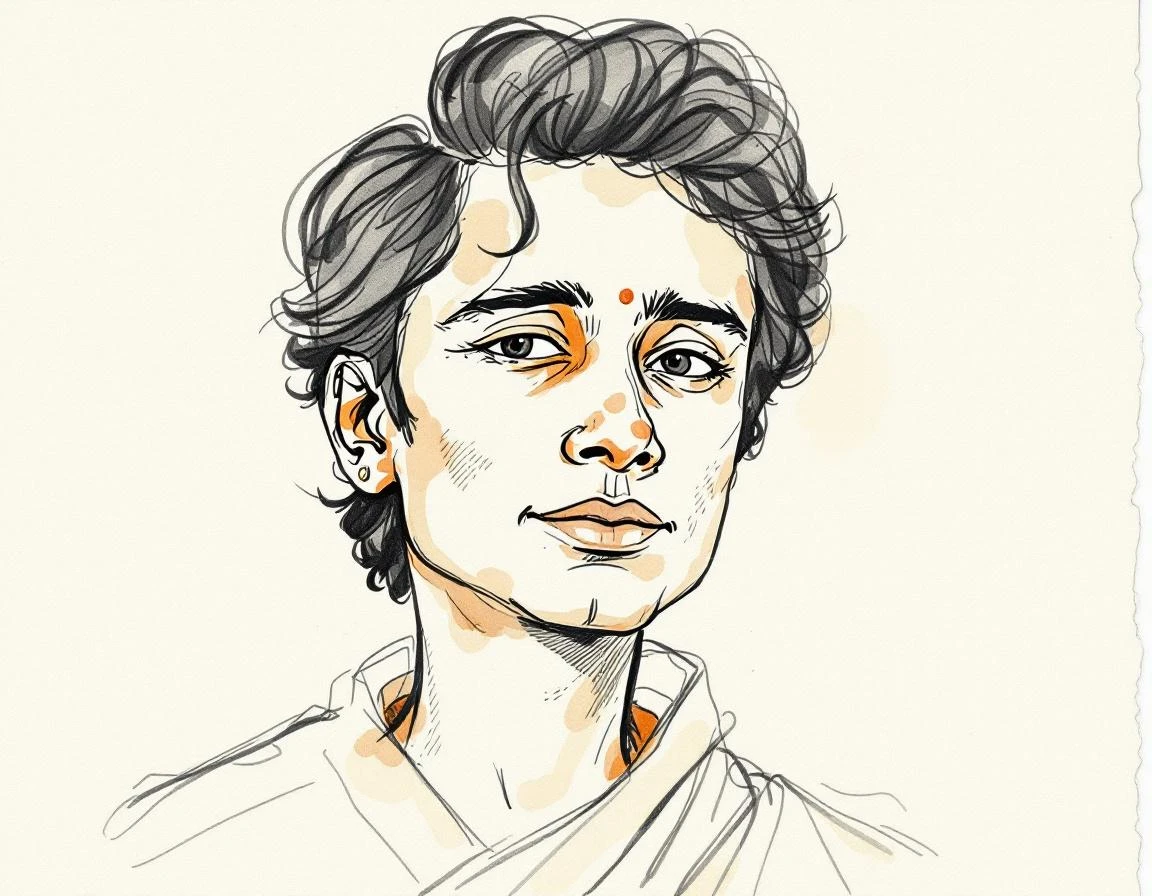


Tamil Name Generator - Character Names from the Dravidian Tradition
Tamil is one of the few languages with an unbroken literary record stretching back to the Sangam era, roughly 300 BCE to 300 CE, and its naming conventions carry that weight. Names in this tradition are not decorative. They draw from Sanskrit loanwords, from the *akam* and *puram* poetry of the classical anthologies, from devotional Shaiva and Vaishnava traditions, from regional caste and clan practices that vary considerably across Tamil Nadu, Sri Lanka, and diaspora communities. The generator works with this material: classical roots, suffix patterns, gendered and neutral forms, the soft phonology of a language where sounds like *zh* and retroflex consonants have no clean English equivalent. Use it for characters who belong to this world, or who carry its inheritance into another one.
Tamil Language and Its Antiquity
Tamil (*தமிழ்*, *Tamiḻ*) is a Dravidian language, not Indo-European, and therefore unrelated to Sanskrit, Hindi, or Bengali. The Dravidian family also includes Telugu, Kannada, and Malayalam; linguists have argued that it once spread across a much larger portion of the subcontinent before Indo-Aryan migration pushed it south. Tamil has the longest continuous written tradition of any Dravidian language, and it sits alongside Sanskrit and Greek as one of the few living languages with an unbroken classical literary history. The *Tolkāppiyam*, a grammar text, is among the oldest surviving grammars of any language. Sangam literature, a body of poetry compiled roughly between 300 BCE and 300 CE, though scholars dispute the dates, is one of the oldest secular literary traditions on record. This antiquity is not merely academic. *Tamil Thaay* (Mother Tamil) is a living cultural concept, and Tamil-language identity has shaped real political history: the Tamil language movement in India mounted sustained resistance to Hindi being imposed as a national language throughout the twentieth century. Tamil is spoken by roughly 75 to 80 million people in India, concentrated in Tamil Nadu, and by large communities in Sri Lanka, Singapore (where it is one of four official languages), Malaysia, and diaspora populations across the UK, Canada, Australia, and South Africa.
Tamil Naming Conventions
Traditional Tamil naming carries no fixed surname system. A person uses their father's given name as a surname, closer to a patronymic than a family name, and in formal usage the father's initial precedes the given name: S. Ramaswamy, where S. stands for Subramanian. The pattern is familiar from cricket: V.V.S. Laxman, where V.V.S. are the initials of the father's names, the full name being Venkata Sai Laxman. Tamil given names draw from three broad sources. Sanskrit has fed the tradition for millennia: Karthik, Priya, Vijay, Nithya, Meenakshi are Sanskrit names that have long since become Tamil ones. Classical Tamil contributes Selvan and Selvi ("precious one"), Malar ("flower"), Kavitha ("poem"), Arun ("dawn"). Then there are names drawn from Tamil deities and saints: Murugan, the Tamil warrior god; Subramaniam; Parvathi; Andal, the *Vaishnava* saint-poetess whose hymns still circulate in temple liturgy. Sri Lankan Tamil naming differs from South Indian Tamil practice in ways that reflect the community's separate political and cultural history.
Using the Generator
For Sangam-era Tamil settings, including the ancient kingdoms of the Chera (centered on the Kerala coast), Chola (centered on the Kaveri delta), and Pandya (centered on Madurai), the period of trade with Rome and Greece, and the period of *Tirukkuṟaḷ* (Thiruvalluvar's ethical text, one of the most translated works in world literature), names should come from the Sangam poetry tradition. The poems preserve personal names from this period: royalty and commoners alike appear in the *aham* (interior/love) and *puram* (exterior/heroic) traditions. For the Chola Empire (9th-13th centuries), one of the great maritime empires of Asia whose navy reached Southeast Asia and whose temple architecture at Thanjavur remains among the most technically demanding in the world, names from the royal tradition include Rajaraja, Rajendra, Kulottunga, Sundara. For contemporary Tamil characters, in Chennai, in Sri Lanka's Tamil-majority north and east, in the diaspora communities of the UK, Canada, and Germany, naming reflects the traditional Tamil system alongside modern pressures. The Sri Lankan Tamil experience of the civil war (1983-2009) has produced a specific diaspora with its own naming conventions and identity politics.
Tamil Final Selection Notes
Tamil names need to match the language, period, region, and community that produced them. The last pass should be plain and practical: put the chosen name beside the character's age, location, family speech, and public identity. If any one of those details fights the name, either revise the biography or choose another candidate. A name that needs constant defense is usually the wrong one for a main character.
Read It against the Household
Household use is the quickest way to find a false note. The strongest choices usually come from ordinary naming pressure: family, faith, migration, class, local pronunciation, and the way a name looks in records. Ask who chose the name, who dislikes it, who shortens it, and who insists on the formal version. In many cultures, the public form and the intimate form are both real. A draft that recognizes that split can show family rank, affection, distance, grief, or migration without stopping to lecture the reader.
Read It against the Archive
Documents create their own pressure. A Tamil name may appear differently in a temple ledger, colonial file, Sri Lankan civil record, Indian school roster, passport, diaspora form, or modern app field. Choose which version the reader sees and keep it consistent. When the story uses a variant, make the reason visible through context rather than a glossary.
Read It against the Genre
The final choice should help the genre do its work. Historical fiction needs a period-aware form; contemporary fiction needs a name that can move through ordinary bureaucracy; fantasy can borrow naming logic while making the invented setting responsible for its own culture. A Tamil result should feel usable in a scene before it feels impressive in a list. If the name gives the next scene a clearer voice, it is earning its place. A Chennai school form and a Jaffna family introduction may ask for different versions. For Tamil specifically, place names, initials, caste signals, devotional forms, and diaspora paperwork deserve separate attention.